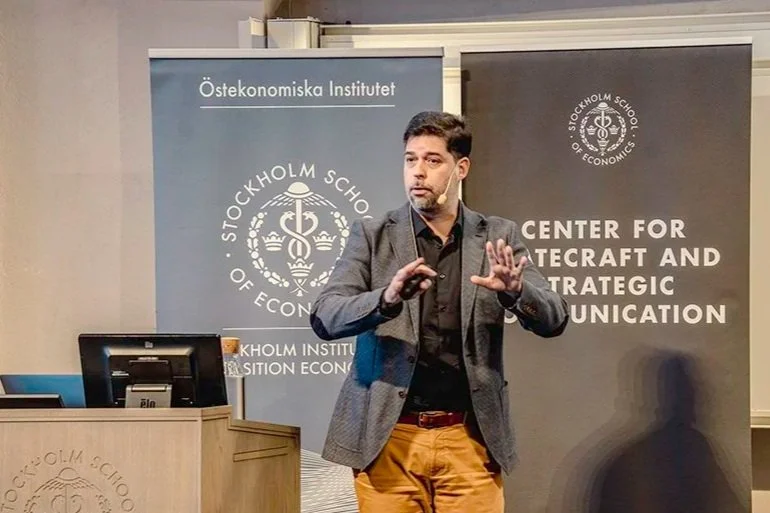
Carlos Diaz Ruiz is an Associate Professor at the Department of Marketing. His research revolves around market-shaping, consumer culture, and disinformation research.
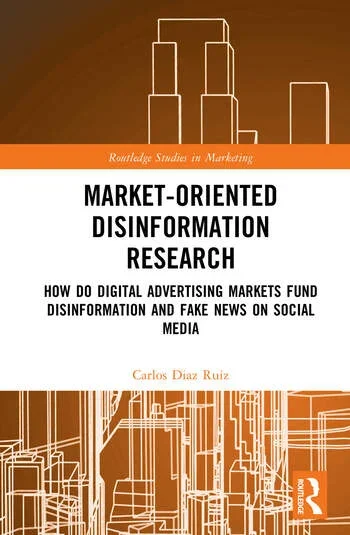
He is the author of Market-Oriented Disinformation Research: Digital Advertising, Disinformation and Fake News on Social Media, a book that studies the money funding disinformation online.
Carlos Diaz Ruiz received the 2025 Thomas C. Kinnear/Journal of Public Policy & Marketing Award for his work on how disinformation spreads in social media echo chambers.
His work on disinformation research has been published in the Journal of Public Policy & Marketing, New Media & Society, and the Journal of Marketing Management.

My research examines how market systems shape public life by blurring the roles of citizens and consumers in online environments. I focus in particular on the socio-technical arrangements of digital platforms, from advertising infrastructures to the creator economy. These arrangements do more than enable commercial exchange: they set the agenda for public debate. This is especially important in a media environment where controversy and conflict can themselves become sources of economic value. My work, therefore, asks how consumption operates as a market-mediated form of public participation in society.
This question cannot be answered by treating consumption merely as a commercial act governed by economic factors. It requires a broader understanding of consumption as constitutive of contemporary social life: as a site where identities are formed, publics are assembled, categories are contested, and political conflicts are made visible. My research agenda advances this understanding in three related directions, which I have pursued chronologically throughout my research career.
First, I studied how markets are structured through consumer representations: how consumers are imagined, segmented, measured, and acted upon.
Second, I examined consumer collectives that affect market formation, focusing on how consumers themselves shape categories and challenge boundaries.
Third, I extend this market-systems perspective to disinformation, where digital advertising and platform monetization shape public knowledge, controversy, and democratic participation.
In the first stream, I examined how consumption is organized through socio-technical assemblages that (re)present consumers. The article, “From Consumers to Consumption: The Socio-Technical Assemblage of the ‘Persona’ in Market Segmentation,” published in the Journal of Business Research, studies personas as market devices that organize and direct managerial attention in markets. The article shows that consumers are produced as representations that not only guide how firms target them but also organize how people take part in consumption practices.
Socio-material representations have been a central concern throughout my research journey. My doctoral dissertation examined how marketers represent consumers in practice, and subsequent publications showed how market research turns consumers into actionable targets for managerial intervention, regardless of how consumers identify themselves. Across this work, I have been interested in how representations become operative: categories, metrics, and models are performative because they organize markets rather than merely describe them. This provides the foundation for my current research on digital platforms that operate through similar representations, such as rankings and engagement metrics, which then organize public participation.
If the first stream examines how market systems act on consumers through representations, the second turns to how consumers act back on market systems. In “Market Bifurcations in Boardsports: How Consumers Shape Markets Through Boundary Work,” published in the Journal of Business Research with Marian Makkar, we analyze how consumers created new sport categories through creative consumption. The article shows how consumers generate new variations of consumer practices that gradually become recognized as distinct markets. In doing so, the article extends my interest in market systems from the representations that organize consumers to the collective practices through which consumers reshape markets.
One example is my research about how the dynamics of consumer collectives generate new forms of consumption. The article “Moments of Luxury: Hedonic Escapism as a Luxury Experience” in the Journal of Business Research explores how consumers generate luxury experiences without a high price tag; instead, consumers co-create extraordinary experiences as a form of hedonic escapism from everyday life.
My third stream brings these concerns together in the context of digital platforms. Platform markets depend on representations of attention: they capture user activity, classify it, price it, and thus, make it actionable for advertisers. In such systems, controversy and conflict are not merely social problems; they are commercially valuable forms of engagement. This is the basis for my research on the consumption and circulation of disinformation on social media. Rather than treating disinformation solely as misleading content, I analyze it as an outcome of market systems in which societal polarization is profitable. In other words, disinformation can be understood as an unintended yet consequential outcome of attention-based platform economies, in which advertising technologies and engagement metrics reward incendiary content.
My 2025 book, Market-Oriented Disinformation Research: Digital Advertising, Disinformation and Fake News on Social Media, consolidates this third stream of research. Published by Routledge, the book develops a market-systems account of disinformation by showing how advertising and monetization technologies turn attention into a measurable and tradable resource. From this perspective, misleading content circulates because platform markets monetize conflict and polarization.
I have extended this market-oriented account of disinformation into consumer society research by examining how misleading content circulates through identity-driven controversies. In “Disinformation and Echo Chambers: How Disinformation Circulates in Social Media Through Identity-Driven Controversies,” published in the Journal of Public Policy & Marketing, Tomas Nilsson and I show how disinformation thrives when consumers build and circulate adversarial narratives against real or imaginary antagonists. This paper received the 2025 Thomas C. Kinnear/Journal of Public Policy & Marketing Award for the most significant marketing contribution to public policy in the last three years, demonstrating how disinformation is sustained through identity projects.
Moreover, my article “Echo Chamber Dynamics on Social Media,” published in New Media & Society, advances this agenda by theorizing echo chambers as socio-technical machines that provoke reactions and extend controversies beyond online groups into wider offline publics. Together, these publications consolidate a research approach that connects disinformation research, market studies, and consumer society by showing how platform markets amplify conflictive forms of consumption.
-
My research integrates consumer culture and market shaping. I build upon my experience as a market researcher and marketing manager to investigate how firms construct consumer insights in ways that shape marketing strategy. My research focuses on the following three streams: (1) insights “as practice.” A stream in which I investigate how firms represent consumers in ways that textbooks fail to prescribe. (2) market-shaping. An empirical phenomenon in which an actor, usually a firm, fundamentally transforms its business landscape to its advantage. (3) Disinformation. I study the social and cultural dynamics of echo chambers in social media.
As a snapshot of my academic career, I defended my dissertation at Hanken (Finland) in 2014. The dissertation resulted in three publications (ABS-3 UK ranking) – Two in Industrial Marketing Management and one in Marketing Theory. Together, they elaborate on how market research is performative, which means it profoundly influences how managers act, or in other words, how market research shapes the strategies managers consider viable.
After my Ph.D., I joined Aalto University for a one-year postdoctoral contract on Consumer Culture. After the postdoc, I joined KEDGE Business School (Bordeaux, France) with my former co-supervisor, Professor Lisa Peñaloza, and the services researcher, Professor Jonas Holmqvist. The outcomes resulted in publications in ABS-3 publications –Journal of Business Research and the European Journal of Marketing. This work conceptualizes consumer tribes and experiential luxury.
I joined the University of Auckland to participate in the market-shaping group led by Prof. Suvi Nenonen and Prof. Kaj Storbacka. My research explored how consumers shape markets. This effort resulted in seven publications in 2020. I will highlight two of them. The publication co-authored with Marian Makkar (RMIT, Australia) in the Journal of Business Research (ABS-3) explores consumer-led innovation, shaping multiple boardsport markets – e.g., kitesurfing, windsurfing, and stand-up paddling. The second collaboration with Prof. Hans Kjellberg (SSE, Sweden) in Marketing Theory (ABS-3) explores how cultural intermediaries exploit contradictions in popular culture to propose ‘feral’ segments.
I am now part of the marketing faculty at Hanken School of Economics in Finland, my alma mater where I continue with my projects on the rhetorical analysis of disinformation and echo chambers.
-
My experience teaching in business schools is international. I have taught at Aalto University and Hanken School of Economics (Finland), Kedge Business School (France), Tec de Monterrey (Mexico), and the University of Auckland (New Zealand). I teach several types of business courses including contemporary marketing, qualitative business research methods, consumer culture, and brand management. My core competencies in teaching include cultural approaches to consumption, contemporary branding strategy, and consumer insights.
Before my academic career, I worked as a consumer insights specialist for 5+ years in both a marketing agency and the client’s side. These managerial experiences provide me with a practical perspective that enhances my teaching. The focus is on interpreting multiple sources of consumer data to generate insights, which I define as actionable findings that can become the backbone of marketing strategy. As such, I emphasize the importance of managerial sensemaking in interpreting data, both qualitative and quantitative.
Currently, I am teaching Consumer Behavior and Strategic Branding.
-
Before joining academia, I was a consumer insights specialist at a market research agency. Also, I was a marketing manager at the flagship airline in Mexico, Mexicana Airlines. Both roles offered a contrasting experience of how ‘consumer insights’ work for the client and agency.
At Mexicana Airlines, my role required an understanding of how consumer insights apply strategically. By commissioning market research projects, commissioning them to agencies, and organizing their findings, I learned to interpret insights according to the firm’s capabilities. This dual experience (agency and client) informs my current research interests and teaching practice.