How does the digital advertising business relate to national security?
I am an academic in a business school, and my training is in marketing and consumer research. What brings this perspective to a discussion of national security and hybrid threats?
The connection lies in the commercial infrastructure that funds and distributes online influence. The same advertising systems that help businesses reach consumers can enable hostile actors to target audiences, amplify divisive narratives, and earn revenue from deceptive content. Understanding these threats therefore requires examining how the advertising business can make disinformation both profitable and politically useful.
On 20–21 October 2026, I participated in Contesting the Grey Zone in the AI Era: Cyber Threats, Strategic Narratives, and Foreign Influence, a workshop in Singapore organized by the Center of Excellence for National Security (CENS) at the S. Rajaratnam School of International Studies (RSIS). The workshop examined how emerging technologies create opportunities for hybrid threats and how institutions can respond.
I joined Paul Charon and Stephen Harper on a panel chaired by Xue Zhang. My presentation examined the commercial infrastructure of AI in the emerging “zero-click economy,” where users receive answers directly from AI interfaces without visiting the underlying sources. I explored how these interfaces could become targets for disinformation through the manipulation of personalized answers, the instructions AI follows, and the data it draws on. My central argument was that understanding these risks requires connecting techniques such as prompt injection and data poisoning with the commercial incentives shaping how AI systems deliver information.
My contribution drew on my research into the commercial organization of disinformation. A market perspective asks how deceptive content becomes financially viable: who pays for its production, how it reaches audiences, and which intermediaries benefit from its circulation. These questions connect the study of marketing and consumption with concerns about information security and democratic resilience.
The distinction between political intent and commercial incentives matters here. Content produced to generate advertising revenue can also serve political objectives. Equally, actors pursuing political influence can exploit tools developed for ordinary commercial activities, including audience targeting and paid promotion. Understanding these relationships requires examining the infrastructure through which attention is bought, sold, and monetized.
I left the workshop with a question: how far can existing approaches to democratic resilience, including fact-checking and media literacy, address an AI-mediated information environment? When answers are personalized, and sources are hard to trace, verification becomes more complicated. What would it take to adapt these approaches to forms of influence embedded in everyday conversations with AI?
Thank you to Benjamin Ang, Xue Zhang, and the entire team at CENS for the invitation.
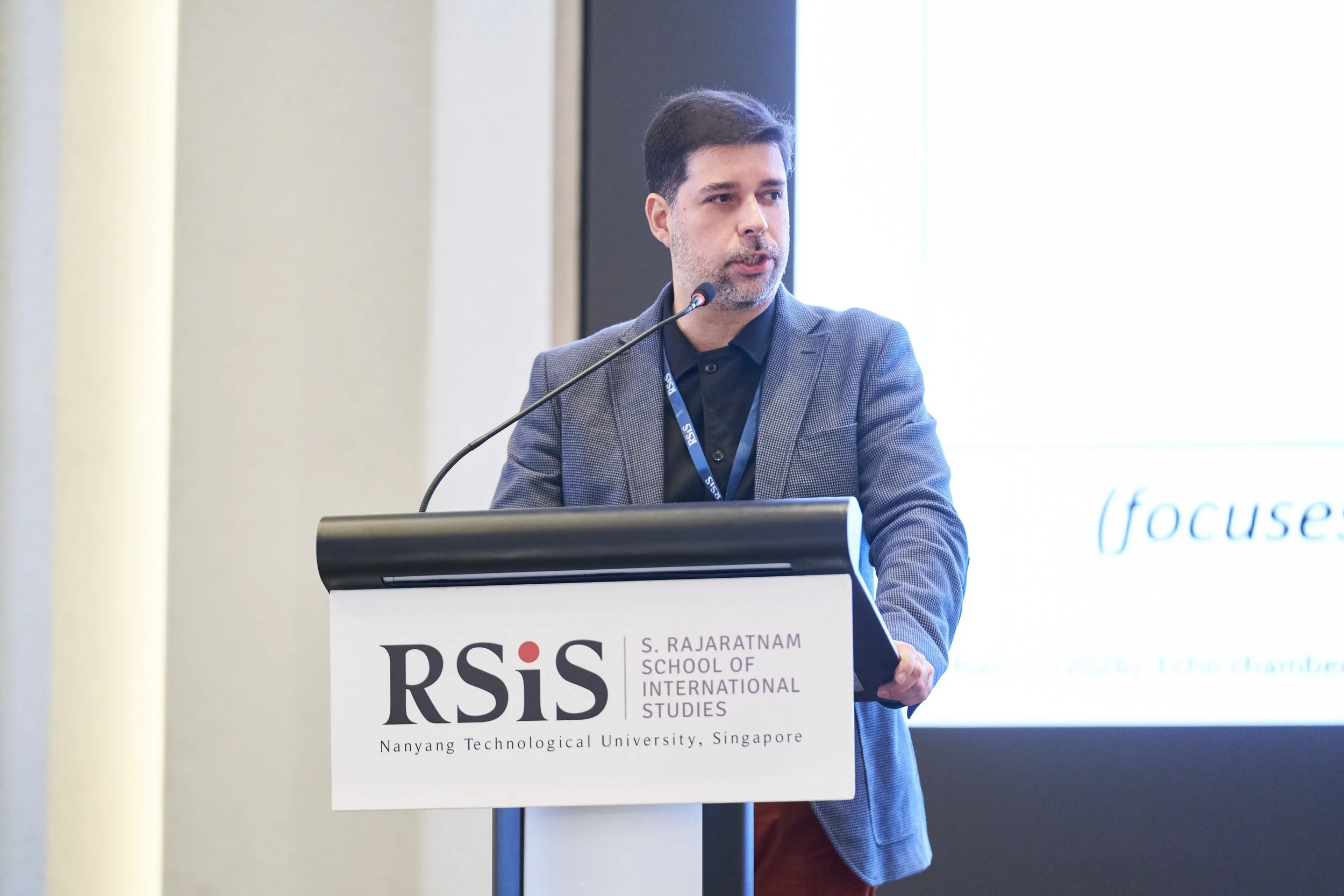
Carlos Diaz Ruiz presents at the CENS Workshop in Singapore.