Echo Chambers on Social Media
Why do polarizing narratives jump from fringe online spaces into mainstream debate? Social Media echo chambers are highly effective for influence operations, but existing academic research has found mixed evidence on whether they even exist.
There is a stark difference between how academics understand how social media echo chambers work and how policymakers understand them.
For academics, it is about how people consume (and reverberate) ideas they already believe (selective exposure, homophily)
For policymakers, it is about the amplification of fringe polarizing beliefs entering the mainstream.
One big problem: researchers study the "echo chamber hypothesis" to describe the phenomenon as a whole, which means rejecting any part of it means rejecting the entire thing. To move the field forward, we need to study the internal dynamics of echo chambers.
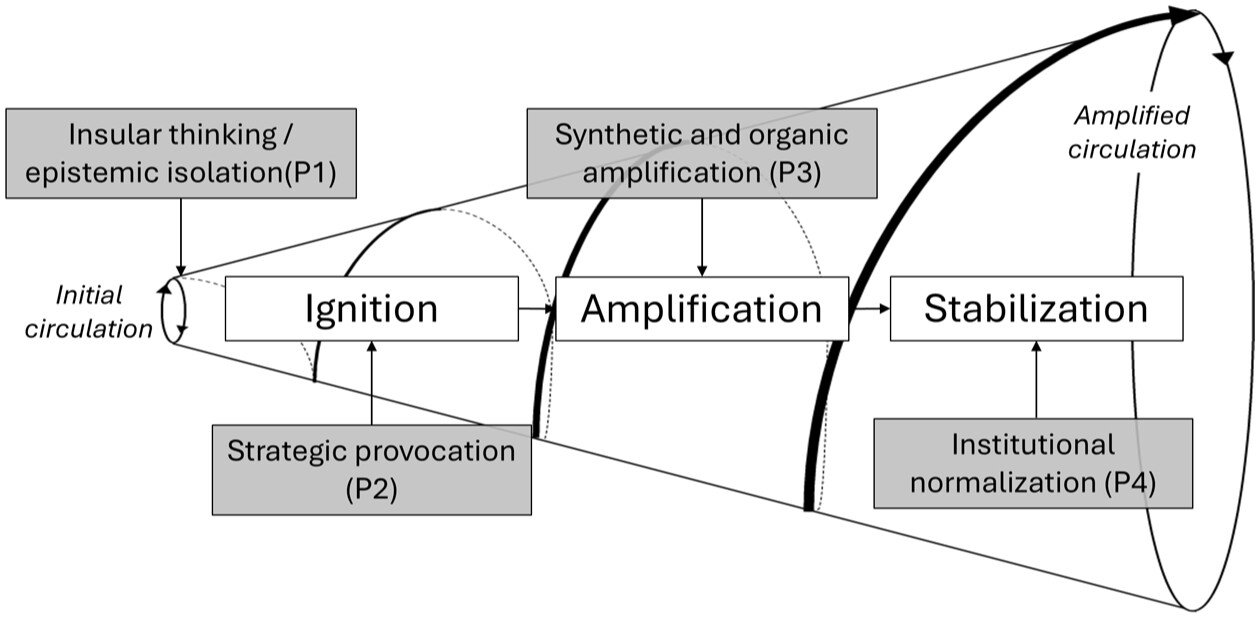
My latest research offers an alternative. Rather than treating echo chambers as a single entity, it explores a socio-technical process with distinct stages.
Ignition: provocative content triggers responses from an insular community
Amplification: The creator economy accelerates both organic (comments made by real people) and synthetic reach (engagement due to algorithms and bots)
Stabilization: When institutions normalize the narrative to offline, moderate audiences.
It helps distinguish the endogenous dynamics of a media phenomenon from exogenous meddling with social media (such as influence operations, disinformation, and bots). Doing so helps move beyond the tired “echo chambers: real or overstated?” debate. Instead, it asks how echo chambers ignite, amplify, and stabilize, and, importantly, it explains how social media’s attention economy helps that process unfold.
This paper is a continuation of my award-winning research paper on how disinformation spreads on social media through identity-driven conflicts. It explains that these dynamics are truly unique to the business model of social media (including the creator economy and AdTech). It is not just because of algorithmic amplification from microtargeting (which is already a big issue), but also because of the overlap between dual-use technologies designed for marketing and repurposed for disinformation.
In other words, echo chambers are socio-technical engagement machines: provocative content ignites reactions, platforms/bots amplify them, and institutions stabilize the narrative for offline publics.
Read both papers for free in the links below
Diaz Ruiz, C. (2026). Echo chamber dynamics on social media. New Media & Society. https://doi.org/10.1177/14614448261441872
Diaz Ruiz, C., & Nilsson, T. (2023). Disinformation and Echo Chambers: How Disinformation Circulates on Social Media Through Identity-Driven Controversies. Journal of Public Policy & Marketing, 42(1), 18-35. https://doi.org/10.1177/07439156221103852